
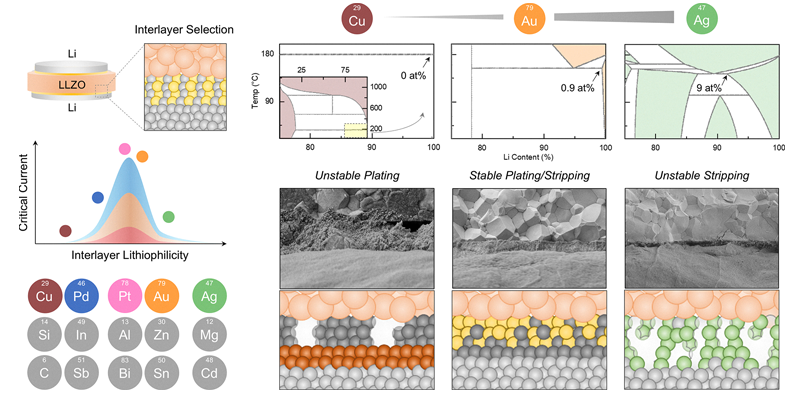
Abstract- The metal–electrolyte interface poses a major challenge in solid-state lithium-metal batteries due to interfacial delamination and dendrite penetration. Although lithium-alloying metal interlayers have been studied to stabilize the interface, a unified framework to compare their relative effectiveness remains limited. This study proposes a lithiophilicity-guided strategy to select optimal anode interlayers for Li-garnet electrolytes, assessing lithiophilicity via lithium solubility in the host metal. Copper, gold, and silver were chosen to represent low, intermediate, and high lithiophilicity, respectively, based on their binary phase diagrams. During cycling, copper's low lithiophilicity led to limited lithium nucleation and uneven growth, whereas silver's high lithiophilicity enabled controlled plating but caused vacancy formation and void aggregation upon stripping. Gold, with intermediate lithiophilicity, achieved balanced performance by supporting uniform plating and stripping at current densities above 1 mA cm−2. Building on the correlation, platinum was identified as a promising candidate with moderate lithium solubility, achieving low interfacial resistance (1 Ω cm2) and a high critical current density (1.2 mA cm−2). Lithiophilicity, a thermodynamically accessible and empirically grounded descriptor, serves as a reliable criterion for metallic interlayer material selection. This guideline can accelerate the discovery of high-performance interlayers and the development of stable solid–solid interfaces in next-generation lithium batteries
 |
Harry Tuller
|